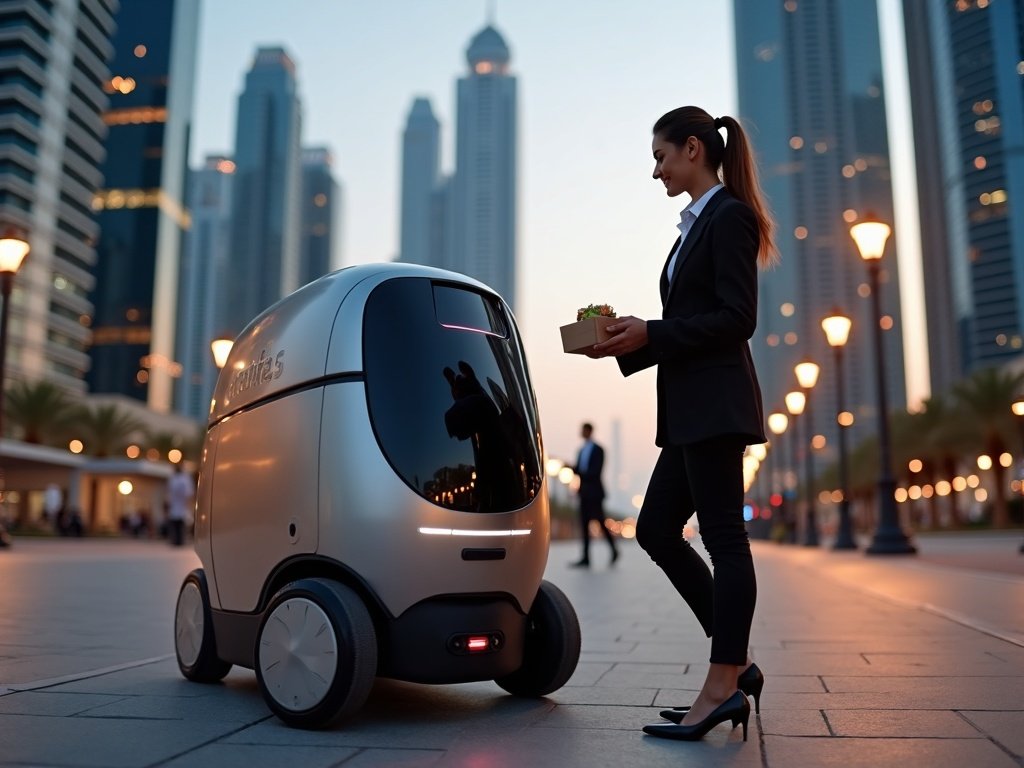
Autonomous delivery robots have begun transporting food orders to residents in select Dubai neighborhoods, marking a significant expansion of the city’s smart city infrastructure. Residents in Dubai Marina, Jumeirah Beach Residence, and parts of Downtown Dubai can now receive food deliveries from sidewalk-navigating robots operated by UAE-based technology companies in partnership with major food delivery platforms.
This development represents one of the most visible implementations of autonomous last-mile delivery in the Gulf region. The robots, which resemble compact cooler units on wheels, use artificial intelligence, camera systems, and real-time navigation to complete deliveries without human drivers. The service launched following months of pilot testing and regulatory coordination with Dubai authorities.
This article covers exactly where robot delivery is available in Dubai, how the technology functions, which companies operate the service, how residents can use it, and what expansion is planned for the coming year.
Where Robot Delivery Is Now Available in Dubai
Robot food delivery is currently operational across several high-density residential and commercial zones in Dubai. The service covers neighborhoods where pedestrian infrastructure supports autonomous robot navigation and where restaurant density justifies the investment in robotic delivery fleets.
- Dubai Marina and Marina Walk
- Jumeirah Beach Residence (JBR) promenade and residential towers
- Downtown Dubai (near Dubai Mall and Business Bay connector)
- Business Bay commercial district
- Jumeirah Lake Towers (JLT) cluster
- Parts of Al Barsha near Mall of the Emirates
Each coverage zone contains designated pickup points where robots pause to await customer retrieval. The operational radius for robot delivery currently extends approximately two kilometers from participating restaurant locations. Companies have announced plans to expand coverage into additional neighborhoods including Palm Jumeirah, Dubai Hills Estate, and Mirdif by late 2026.
How Autonomous Robot Delivery Works
The delivery robots navigate Dubai’s sidewalks using a combination of cameras, lidar sensors, and GPS positioning systems that feed data to onboard artificial intelligence processors. These systems enable the robots to detect and avoid pedestrians, parked vehicles, construction barriers, and other obstacles in real time while maintaining a walking-speed pace of approximately five kilometers per hour.
Each robot operates with continuous remote monitoring from a central control center where human operators can intervene if the robot encounters situations it cannot resolve autonomously. The operators can pause robot movement, reroute around obstacles, or dispatch maintenance teams if mechanical issues arise. All robots are equipped with emergency stop buttons that pedestrians can activate if needed.
When a food order arrives at the customer’s specified delivery location, the robot sends a notification through the ordering app with a code. Customers approach the robot, enter the code on a touchscreen interface, and the robot’s storage compartment unlocks to release the order. The compartment is temperature-controlled to keep food warm or cool during transit.
The robots weigh approximately sixty kilograms and travel on six wheels designed for stability on uneven sidewalk surfaces. They can complete deliveries in most weather conditions common to Dubai, though extreme sandstorms or heavy rain may temporarily suspend operations.
The Companies Behind Dubai’s Robot Food Delivery
The robot delivery service in Dubai involves both international technology companies and UAE-based startups operating under partnerships with established food delivery platforms.
UAE robotics company Fetchr originally developed the robot delivery technology and operated early pilot programs in Dubai starting in 2023. The company partnered with delivery platform Talabat to integrate robot delivery as an option for participating restaurants. Fetchr received operating approval from the Dubai Roads and Transport Authority following demonstration projects in controlled environments.
International autonomous delivery company Starship Technologies, which operates robot delivery services in multiple European cities and U.S. campuses, announced a partnership with Emirates df& to launch services in select Dubai neighborhoods. The company leverages experience from over five million autonomous deliveries completed globally.
Restaurant and grocery delivery platform InstaShop integrated robot delivery options into its app following a pilot program with Dubai-based logistics startup Replatform. The partnership enables InstaShop to offer robot delivery as a cost-effective alternative for small and medium-sized restaurant partners.
These companies operate under regulatory frameworks established by Dubai’s Transportation and Traffic Agency, which developed guidelines for autonomous delivery devices on public sidewalks in 2024.
Using Robot Delivery: A Guide for Dubai Residents
Residents in service areas can access robot delivery through several steps using their existing food delivery applications. The process differs slightly depending on which platform handles the order.
- Open the Talabat, InstaShop, or Careem Eats application on your smartphone
- Search for participating restaurants that display the robot delivery icon in their menu
- Add items to your cart and proceed to checkout
- Select “Robot Delivery” as your delivery option when available
- Enter your delivery address within the active robot coverage zone
- Confirm the order and make payment through the app
Once the restaurant prepares the food and hands it to the robot at a designated loading point, the robot begins its journey to your location. You can track the robot’s progress in real time through the app, similar to how you would track a human delivery driver.
When the robot arrives at your delivery address, you receive a notification with a pickup code. Walk to the robot, tap the code into the touchscreen, and retrieve your order from the unlocked compartment. The robot can wait at the pickup location for up to fifteen minutes before the order is returned to the restaurant.
Robot delivery fees are currently comparable to standard delivery charges, typically ranging from AED 5 to AED 10 per order. Some platforms offer free robot delivery for orders above a minimum threshold, such as AED 50.
Dubai’s Smart City Vision and Robot Delivery
The introduction of autonomous food delivery robots aligns with Dubai’s broader strategy to become one of the world’s smartest cities. The Dubai Smart City initiative, launched under the directive of Sheikh Mohammed bin Rashid Al Maktoum, aims to integrate advanced technology into urban infrastructure across transportation, governance, and citizen services.
Robot delivery addresses several objectives within this framework. The robots reduce the number of delivery vehicles on Dubai’s roads, contributing to less traffic congestion in dense neighborhoods. They operate on electric power, eliminating direct emissions from last-mile deliveries. The autonomous systems can function around the clock without shift scheduling constraints, potentially improving delivery availability during late-night hours.
The Dubai Future Foundation identified autonomous delivery as a priority area for pilot programs under its innovation sandbox framework. The foundation supported regulatory discussions that resulted in the 2024 guidelines for autonomous delivery devices, creating a clear legal pathway for companies to operate robot fleets in public spaces.
Dubai’s investment in autonomous delivery technology also positions the city as a testing ground for innovations that may spread to other Gulf Cooperation Council countries. The success of robot delivery in Dubai could accelerate similar implementations in Abu Dhabi, Riyadh, and Doha.
What’s Next for Robot Delivery in Dubai
Companies operating robot delivery services in Dubai have announced expansion timelines that could significantly increase coverage across the city by the end of 2027. If expansion proceeds as planned, robot delivery could become available in most major residential communities in Dubai within the next eighteen months.
Planned expansions include coverage for Deira, Al Rigga, and surrounding neighborhoods in Dubai’s eastern corridor. Companies are also exploring deployment in Sharjah and Ajman as part of cross-emirate pilot programs.
Future robot generations under development include larger capacity units capable of handling family-sized meal orders, refrigerated compartments for grocery delivery, and heated containers for maintaining food temperature during longer delivery routes. Some companies are testing nighttime operations with enhanced lighting systems for safer navigation after dark.
Regulatory developments on the horizon include potential requirements for robot identification markings, increased insurance coverage mandates, and noise level restrictions for residential neighborhood operations. The Dubai Roads and Transport Authority is expected to release updated guidelines in early 2026.
Frequently Asked Questions
Which Dubai neighborhoods have robot food delivery?
Robot food delivery is currently available in Dubai Marina, Jumeirah Beach Residence, Downtown Dubai, Business Bay, Jumeirah Lake Towers, and parts of Al Barsha. Coverage is expanding to additional neighborhoods including Palm Jumeirah and Dubai Hills Estate.
How do I order food using robot delivery in Dubai?
Open the Talabat, InstaShop, or Careem Eats app, select a restaurant displaying the robot delivery icon, choose Robot Delivery at checkout, and enter your address within the service zone. Track the robot through the app and use your pickup code to retrieve your order.
Are robot deliveries more expensive than regular delivery in Dubai?
Robot delivery fees range from AED 5 to AED 10, comparable to standard delivery charges. Some platforms offer free robot delivery for orders above minimum thresholds, typically around AED 50.
How do delivery robots navigate Dubai’s streets safely?
Delivery robots use cameras, lidar sensors, and GPS to navigate sidewalks while detecting and avoiding pedestrians, vehicles, and obstacles. Human operators monitor each robot remotely and can intervene if the robot encounters situations it cannot resolve autonomously.
Can robot delivery work in Dubai’s extreme summer weather?
Robots can operate in most weather conditions common to Dubai, including high temperatures. Extreme sandstorms or heavy rain may temporarily suspend operations, but the temperature-controlled compartments protect food during normal conditions.
Will robot delivery expand to other areas in Dubai?
Yes, companies plan to expand robot delivery to Deira, Al Rigga, Palm Jumeirah, Dubai Hills Estate, and Mirdif by late 2026 and 2027. Pilot programs in Sharjah and Ajman are also under discussion.
Robot food delivery has moved from experimental technology to operational reality in Dubai, giving residents in select neighborhoods access to a new delivery option that operates autonomously on city sidewalks. The service works through existing food delivery apps, costs roughly the same as traditional delivery, and expands to additional neighborhoods over the coming year.
For UAE residents in areas where robot delivery is available, the technology offers a glimpse of how autonomous systems might increasingly handle last-mile logistics across the city. For now, ordering a meal delivered by a robot is as simple as selecting the option in your delivery app and waiting for the notification that your food has arrived at your doorstep.