




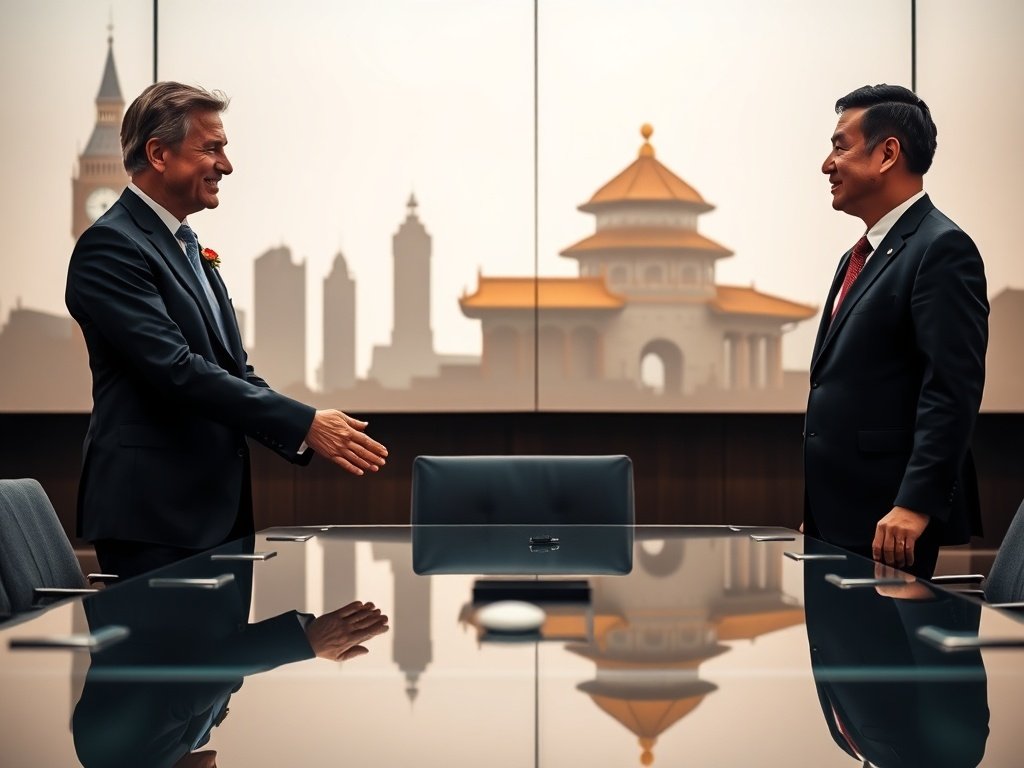
A New Chapter in Anglo‑Chinese Relations
On the evening of , Prime Minister Keir Starmer stepped onto Chinese soil – the first British head of government to do so since 2018. Accompanied by a delegation of more than fifty senior executives from renewable energy, finance, automotive and fintech sectors, the visit was billed by Downing Street as a “business‑first” mission aimed at re‑igniting commercial ties with the world’s second‑largest economy (source: Downing Street press release).
Why the Gap Matters
The previous British premier to meet President Xi Jinping was Theresa May in November 2018, a trip that unfolded amid a Hong Kong protest crackdown, concerns over Beijing’s role in the Russian invasion of Ukraine and the UK’s decision to bar Huawei from its 5G networks. In the years that followed, mutual suspicion hardened, with British intelligence agencies publicly accusing China of systematic espionage (source: UK National Security Council).
Since the 2024 general election, the Labour government has been tasked with reviving an economy still reeling from post‑Brexit trade disruptions, supply‑chain fragility and a slowdown in foreign direct investment.
The Business Delegation: A “Seize‑the‑Moment” Pitch
Starmer told the business cohort that the United Kingdom must “look beyond the Atlantic and the European continent to capture the growth that is happening in Asia.” He urged CEOs to view China as a partner for joint ventures in green technology, digital infrastructure and advanced manufacturing.
Key participants included:
- A consortium of UK renewable‑energy developers targeting offshore‑wind projects.
- A fintech group seeking to navigate the People’s Bank of China’s digital‑currency framework.
- An automotive supplier aiming to tap China’s electric‑vehicle push.
Collectively, the delegation accounts for roughly £3 billion in annual turnover, underscoring the economic stakes.
Diplomatic High‑Points: Meetings with Xi and Li
The following day, Starmer met President Xi Jinping and Premier Li Qiang at the Great Hall of the People. Topics covered trade liberalisation, climate cooperation and the status of Hong Kong. The British side pressed for greater market access for services, which make up more than half of the UK’s trade surplus with China (source: UK Trade Department).
Sources close to the negotiations describe the dialogue as cordial but guarded. Starmer raised alleged cyber‑espionage, prompting Chinese officials to propose a joint working group on cyber‑security – a proposal now under review by the UK’s National Cyber Security Centre.
Security Concerns: A Persistent Shadow
Outside the embassy, Starmer warned that “engagement does not mean turning a blind eye to threats.” British security services have long warned that Chinese intelligence targets political figures, critical‑infrastructure firms, research institutions and diaspora communities.
The Ministry of Defence confirmed an accelerated review of “foreign‑state influence,” particularly in semiconductors and telecommunications. Findings will feed into a broader “Strategic Outlook” to be presented to Parliament later this year.
The United States Factor
The visit occurs while the United States under President Jenna Morrison continues to impose tariffs on Chinese steel and champions a “technology decoupling” strategy. London therefore aims to balance the “special relationship” with Washington while asserting an independent trade policy that diversifies the UK’s export base.
Analysts at the Royal United Services Institute note that “Britain’s leverage lies in its ability to act as a bridge between the West and the East, provided it can convincingly safeguard its own security architecture.”
China’s Narrative: Stability Amid Global Turbulence
Beijing framed the visit as an opportunity to showcase reliability. A senior Ministry of Foreign Affairs official described the United Kingdom as “a valuable partner whose commitment to multilateralism aligns with China’s vision of a balanced international order” (source: MFA briefing).
China’s domestic push to achieve carbon neutrality by 2060 requires foreign investment in clean‑energy technologies, making British expertise in offshore wind and hydrogen especially attractive.
Economic Stakes: Numbers Behind the Diplomacy
Current UK‑China trade stands at roughly £15 billion annually, with a modest services surplus for the UK but a sizable goods deficit. A forecast by the Centre for Economic Policy Research suggests a potential 10‑15 % uplift in bilateral trade over the next five years if the diplomatic overtures translate into concrete agreements.
Joint research programmes in green technology could attract an estimated £1.2 billion in new investment, supporting the UK’s net‑zero commitments.
Political Repercussions at Home
Opposition parties warn that “economic enthusiasm must not eclipse human‑rights concerns,” citing ongoing restrictions in Hong Kong and Xinjiang. Within Labour, a faction of MPs is calling for a parliamentary committee to scrutinise any trade deals that may compromise UK values.
Supporters argue that a pragmatic approach to China is essential for economic recovery, emphasizing the need to “deliver jobs and growth for ordinary Britons.”
Looking Ahead: What the Visit Could Yield
Immediate outcomes are expected to include memoranda of understanding on renewable‑energy cooperation, fintech pilots and academic exchanges. In the longer term, the UK may pursue a “Comprehensive Strategic Partnership” similar to those with Japan and Canada, featuring regular high‑level dialogue on security, trade and climate.
The durability of any agreement will hinge on how both sides navigate unresolved flashpoints such as Hong Kong autonomy, cyber‑espionage allegations and China’s alignment with Moscow.
Conclusion: A Calculated Gamble
Prime Minister Keir Starmer’s historic foray into China reflects a calculated gamble by a government seeking to balance economic imperatives with security concerns in an increasingly multipolar world. Success will be measured not only by signed contracts but also by the robustness of safeguards protecting democratic institutions and critical infrastructure.
As the delegation departs Beijing, the emerging diplomatic narrative is one of cautious optimism – an acknowledgement that engagement, when coupled with vigilance, can serve both national prosperity and security.