




The Immediate Crisis
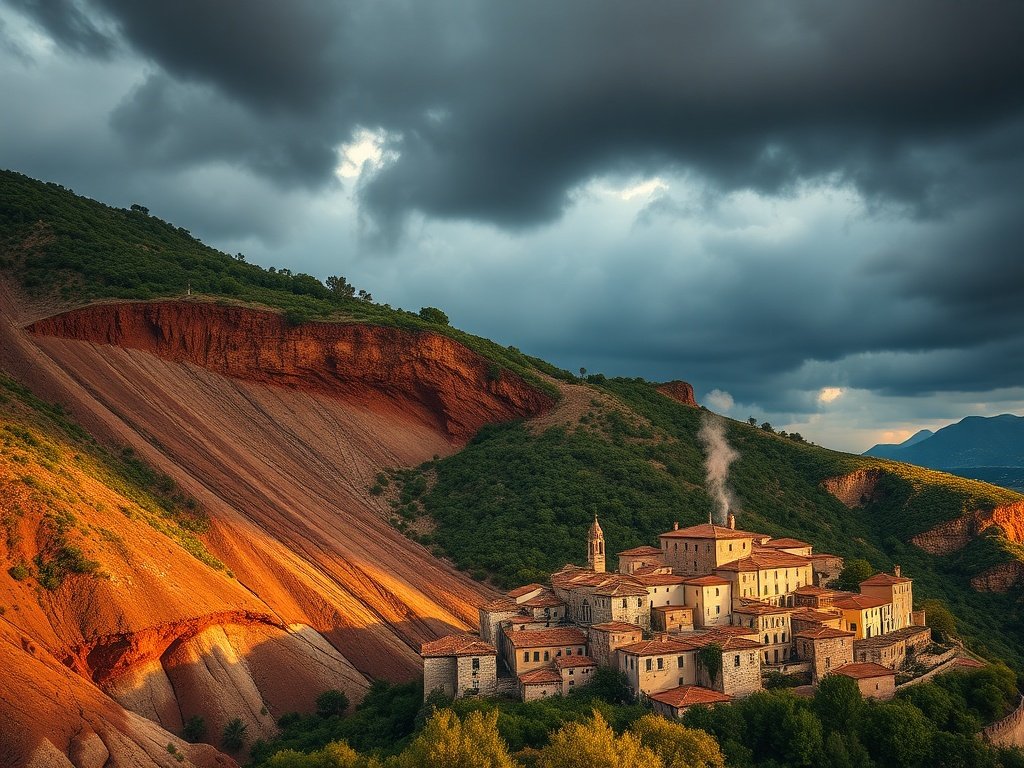
A massive landslide erupted on Sunday after a powerful Mediterranean storm saturated the soft sandstone‑clay layers that underlie Niscemi, a town of roughly 25,000 residents on the rolling hills of south‑central Sicily. The failure created a deep, four‑kilometre fissure that forced the evacuation of about 1,500 people and prompted the Civil Protection Agency to declare the area a “red zone.”
Emergency crews are monitoring the movement with drones and satellite imagery. Civil Protection’s emergency management chief, Luigi D’Angelo, warned that “we need to wait for the rains to stop and for the soil moisture to decrease,” noting forecasts of additional heavy precipitation that could trigger another 20‑metre slab of earth.
There have been no casualties, but the human cost is evident. Fifty‑eight‑year‑old Gaetano Ferrera left his home clutching a few belongings, saying, “I have lived here since I was a child… Being left without anything is bad, it’s bad.” A mobile kitchen now provides hot meals while police patrol empty streets.
A Town Built on Unstable Ground
Niscemi’s geology—soft sandstone interbedded with clay—has long predisposed the area to slope failures. In 1997 a similar landslide devastated the same neighbourhood, leaving a legacy of delayed compensation and lingering mistrust.
Geologist Giuseppe Amato, head of water resources for the NGO Legambiente, called the event “another alarm bell,” urging changes in building practices and land‑use planning. His view aligns with research showing that the Mediterranean basin is becoming a climate‑change “hot spot.”
- ISPRA estimates over one million Italians now live in “high or very high risk” landslide zones.
- Sicily recorded 48 exceptional weather events in 2025, ranging from violent winds to record‑breaking heatwaves.
- Repeated saturation of vulnerable slopes is destabilising areas once considered safe for habitation and agriculture.
Government Response and Political Stakes
Prime Minister Giorgia Meloni visited Niscemi on Wednesday, flying over the scarred hillside to assess damage. She pledged “quick help,” referencing the unresolved grievances from the 1997 disaster.
Meloni cautioned that the final number of permanently displaced residents remains uncertain as the slide continues to move. The government’s response must balance immediate relief—temporary housing, food distribution, medical support—with longer‑term measures such as:
- Land‑use planning that integrates high‑resolution hazard mapping.
- Infrastructure reinforcement and drainage improvements.
- Early‑warning systems and nature‑based solutions (reforestation, terracing).
Civil Protection’s D’Angelo added that engineering teams are installing temporary barriers and evaluating slope‑stabilisation options.
Voices from the Ground
Rosario Cona, a 45‑year‑old farmhand, described the event simply: “The land simply dropped away.” He sees the landslide as part of a “normality” that now requires responsibility from the present generation. “We have to take responsibility. The time for sleepwalking is over,” he said, while reaffirming his intention to stay: “I was born here, and I will die here.”
The town’s economy—centered on olives, citrus, wheat and small‑scale commerce—faces a prolonged disruption as fields are scarred and housing stock dwindles.
Climate Change, Governance, and the Path Forward
Scientists warn that rising temperatures will increase the intensity and frequency of heavy rainfall, especially in regions with saturation‑prone geology. In Sicily, the mosaic of limestone, sandstone and volcanic deposits makes the risk matrix acute.
Policy experts advocate a two‑pronged mitigation strategy:
- Integrate detailed hazard mapping into land‑use planning to restrict construction on unstable slopes.
- Invest in nature‑based solutions that improve slope stability while delivering carbon‑sequestration and biodiversity benefits.
While Italy’s national disaster‑risk reduction strategy now references these principles, implementation is uneven due to funding constraints, bureaucratic inertia, and competing political priorities. The Niscemi landslide could catalyse more decisive action if emergency relief is linked to long‑term resilience projects.
Compensation mechanisms also need reform. The delayed reparations after the 1997 disaster eroded public trust, underscoring the importance of transparent, timely, and adequately funded schemes to maintain social cohesion.
Looking Ahead
With more rain forecast, the priority is to safeguard lives, provide essential services to the displaced, and prevent further property loss as the hillside continues its slow movement. Subsequent steps will involve structural assessments, decisions on demolition versus reinforcement, and community dialogues about the future of the affected neighbourhoods.
For Gaetano Ferrera, the uncertainty of returning home mirrors a collective dilemma. For Rosario Cona, the resolve to rebuild reflects a cultural resilience that has endured centuries. The ultimate outcome—whether Niscemi becomes a model of adaptation or a cautionary tale—depends on the speed and coherence of the response that follows this dramatic, earth‑shaking event.