






NHS England launches AI‑robotic bronchoscopy pilot to speed lung‑cancer diagnosis
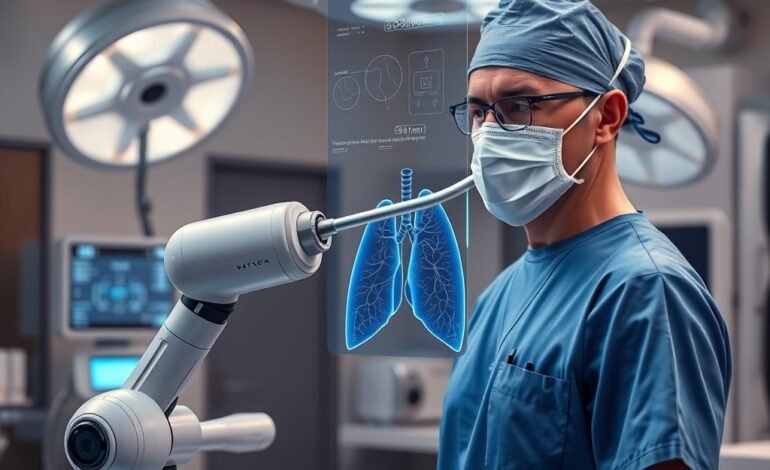

– NHS England is rolling out a six‑month, multi‑centre trial that integrates artificial‑intelligence (AI) software with robot‑assisted bronchoscopy. The programme seeks to reduce the time from suspect CT scan to definitive lung‑cancer diagnosis from the current median of 21 days to under ten days.
Why speed matters
Lung cancer accounts for roughly 48 000 new cases and more than 35 000 deaths each year in the United Kingdom. Five‑year survival exceeds 70 % for stage I tumours but falls below 10 % for stage IV disease. National targets require a maximum 62‑day interval from urgent referral to first treatment, yet many patients wait weeks for radiology review and tissue sampling.
“The diagnostic bottleneck is a real, life‑changing problem,” said Dr Helen Murray, Director of Cancer Services at NHS England.
The technology behind the trial
AI‑driven image analysis
A deep‑learning algorithm, trained on more than 200 000 annotated chest CT scans, automatically flags nodules, measures size, and assigns a malignancy probability score. Validation studies reported 94 % sensitivity and 88 % specificity, outperforming average radiologist performance in retrospective tests.
Robotic bronchoscopy
The trial uses a next‑generation, computer‑navigated bronchoscope with a flexible, steerable catheter. Real‑time positional feedback stabilises the instrument, allowing physicians to reach peripheral lesions that are difficult to biopsy with conventional scopes.
Combined workflow
AI triages CT scans, prioritising high‑risk cases for immediate bronchoscopy. The robot then obtains tissue samples quickly and with minimal discomfort. The primary endpoint is a reduction of the median imaging‑to‑pathology interval from 21 days to under ten days.
Trial design and participating sites
The pilot runs for six months across five NHS Trusts selected for high lung‑cancer caseloads and robust digital infrastructure:
- Guy’s and St Thomas’ (London)
- Manchester University Hospitals
- Leeds Teaching Hospitals
- Royal Free London
- University Hospital of Wales
Each site will embed the AI software into its radiology PACS and install a robotic bronchoscopy suite within interventional pulmonology.
Fast‑track patient pathway
- CT scan – AI processes the scan and generates a risk score within minutes.
- Clinical review – Multidisciplinary team confirms the need for tissue diagnosis.
- Robotic bronchoscopy – Same‑day or next‑day procedure guided by fluoroscopic and electromagnetic navigation.
- Pathology – Samples sent to a central hub for rapid molecular testing, enabling targeted therapy within two weeks of referral.
Anticipated benefits and broader implications
- Clinical impact: Modelling suggests a 30 % reduction in diagnostic delay could raise five‑year survival by up to 4 percentage points nationwide.
- Resource optimisation: Automating nodule detection frees radiologists for complex cases and may reduce overtime and burnout.
- Economic considerations: With £250 million earmarked for digital cancer transformation, a favourable cost‑benefit ratio could justify national rollout.
- Data governance and equity: The AI operates under the NHS AI Lab framework, using a demographically diverse training set to mitigate bias.
Challenges and cautions
Technical integration may require bespoke middleware and extensive staff training. The robot’s reliance on high‑resolution imaging adds operational complexity, and the upfront cost of a system can exceed £1 million.
“AI should augment, not replace, clinical judgment,” warned Professor James Khan, Head of Respiratory Medicine at Manchester University Hospitals.
Patient perspective
Patient groups have welcomed the initiative. Sarah Ellis of Lung Cancer UK noted that faster diagnosis could reduce the “psychological toll” of prolonged waiting.
The trial will capture patient‑reported outcome measures (PROMs) covering pain, anxiety, and overall satisfaction, informing refinements before any wider rollout.
Looking ahead
If the pilot meets its primary endpoints—cutting diagnostic time by at least 40 % while maintaining accuracy—NHS England plans to expand to an additional 20 Trusts by 2028. Parallel research into AI‑driven histopathology and rapid specimen transport suggests a broader vision of an end‑to‑end digital oncology ecosystem.
Conclusion
The AI‑assisted imaging and robot‑guided bronchoscopy trial represents a strategic response to the urgent public‑health challenge of lung‑cancer mortality. By potentially compressing weeks of diagnostic delay into days, the programme aims to improve survival, ease radiology pressures, and demonstrate a scalable model for high‑value digital health innovation in the United Kingdom.