






NHS England Launches AI and Robotic Trial to Speed Lung Cancer Diagnosis

Why the Innovation Is Needed
Lung cancer remains the United Kingdom’s leading cause of cancer‑related death, accounting for roughly 13 % of all cancer fatalities each year.[1] Approximately 48 000 new cases are diagnosed annually, yet the five‑year survival rate hovers just above 15 %.[1] A major contributor to these outcomes is the delay between first clinical suspicion and a confirmed tissue diagnosis, often six weeks or longer.[2]
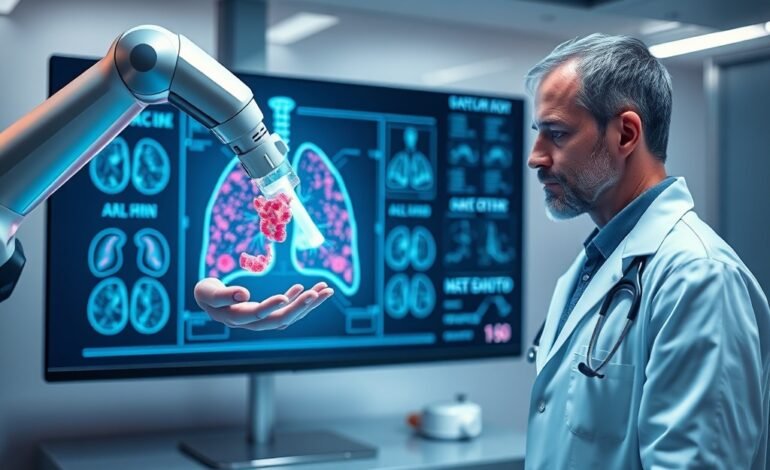
The NHS diagnostic chain is strained by high demand for CT scans, shortages of specialist radiologists, and time‑intensive conventional bronchoscopic biopsies. The new pilot targets these bottlenecks by pairing AI‑driven image interpretation with robotic bronchoscopy that can navigate the bronchial tree with millimetre precision.
AI‑Driven Image Analysis
The AI component relies on a deep‑learning model trained on millions of annotated CT scans from NHS trusts and international datasets. It can detect pulmonary nodules as small as 3 mm, assess malignancy‑associated morphology, and assign a risk score in real time after a low‑dose CT scan.
Feasibility studies published in peer‑reviewed journals show the algorithm can raise nodule‑detection sensitivity by up to 15 % while maintaining specificity, and it reduces radiologists’ workload by pre‑screening scans.[3]
Robotic Bronchoscopy: Precision Sampling
Robotic bronchoscopy overcomes the reach limitations of conventional flexible bronchoscopy. The selected platform features a computer‑controlled catheter steered with sub‑millimetre accuracy and integrated navigation software that aligns sampling tools directly with AI‑identified targets.
Data from US and European centres report diagnostic accuracy of 85–90 % for peripheral nodules, compared with 60–70 % for standard techniques.[4]
Pilot Design and Participating Sites
The trial will run across six NHS Trusts, enrolling up to 2 000 patients per site over 18 months:
- Guy’s and St Thomas’
- Manchester University Hospitals
- Leeds Teaching Hospitals
- Royal Free London
- University Hospitals Bristol
- Royal Cornwall Hospitals NHS Trust
Key Protocol Elements
- Dual‑modality workflow: Low‑dose CT → AI analysis → same‑day robotic bronchoscopy for high‑risk nodules.
- Standardised reporting: Unified electronic template captures AI risk scores, procedural details, and histopathology.
- Outcome metrics: Primary – time from imaging to definitive diagnosis and diagnostic accuracy. Secondary – patient experience, complications, cost‑effectiveness, treatment timeline impact.
- Governance: Oversight by the NHS Health Research Authority with a patient‑advisory board and strict data‑privacy safeguards.[5]
Anticipated Benefits and Economic Impact
If the pilot shortens the diagnostic pathway by days to weeks, earlier‑stage detection could expand eligibility for curative surgery or stereotactic body radiotherapy, both linked to markedly better survival.
NHS Digital’s economic modelling estimates that a 20 % reduction in diagnostic delay could save the health service over £150 million annually through fewer emergency admissions, reduced repeat imaging, and improved patient productivity.[6]
Although the robotic system requires significant upfront capital, higher procedural success rates and fewer complications are expected to amortise the investment over time.
Challenges and Points of Caution
Potential algorithmic bias is a concern, especially if training data under‑represent certain ethnic groups or atypical imaging patterns. The trial includes continuous performance monitoring and a feedback loop for radiologists to flag false results.[7]
Workforce implications involve specialised training for bronchoscopists, nurses, and technicians. NHS England plans a national curriculum and certification pathway, but scaling expertise will take time.
Patient acceptance varies; the advisory board will guide communication to ensure transparency about risks, benefits, and the role of human oversight.
Future Outlook
Success could pave the way for AI‑enhanced pathways in other cancers—such as AI‑guided mammography with robotic biopsy or AI‑directed colonoscopic polyp removal. The technology stack—high‑performance computing, cloud analytics, and precision robotics—also holds promise for interventional cardiology, neurosurgery, and beyond.
Conclusion
The NHS England pilot merges machine‑learning image interpretation with robot‑assisted tissue acquisition to confront the long‑standing lag between suspicion and confirmation of lung cancer. By generating robust evidence on speed, accuracy, safety, and cost‑effectiveness, the trial could establish AI and robotics as routine allies of clinicians, ultimately improving survival for thousands of patients each year.