




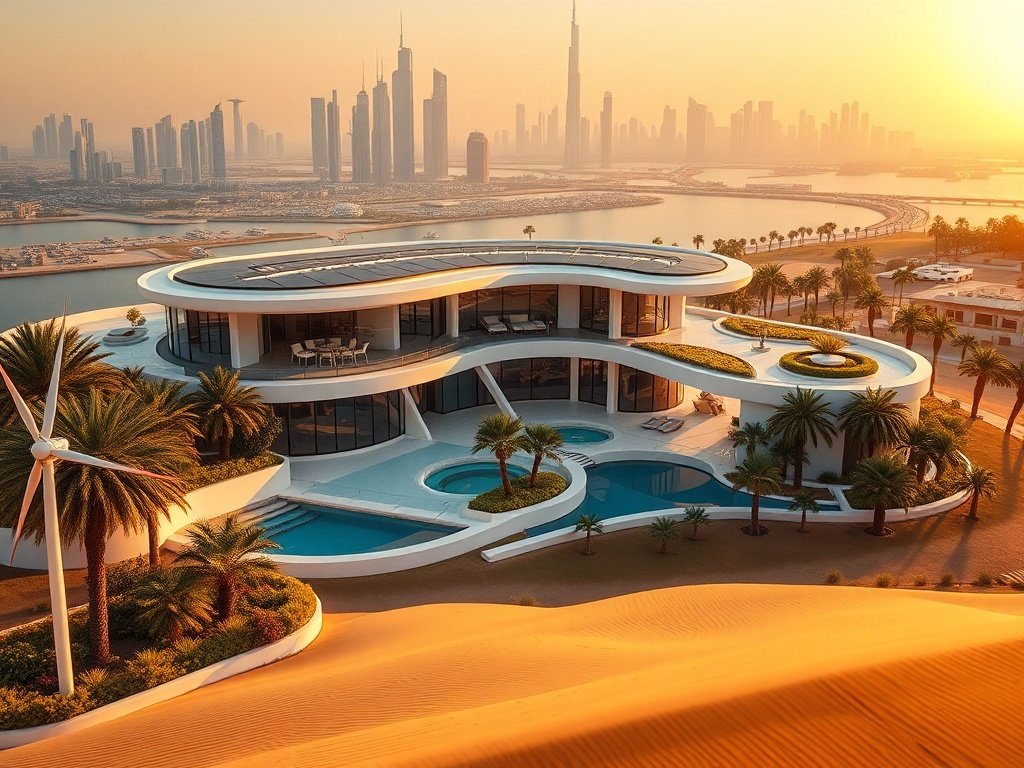
– Dubai Municipality announced a worldwide design contest that seeks the first residential villa capable of operating with zero net carbon emissions. The challenge is positioned as a showcase for ultra‑efficient energy systems, water autonomy and a new luxury‑living paradigm aligned with the United Arab Emirates’ “Net‑Zero by 2050” agenda.
A vision that stretches beyond borders
The competition arrives as Dubai cements its reputation as a laboratory for futuristic urban development. Over the past decade the city has delivered landmark projects—from the world’s tallest tower to sprawling smart‑city districts—testing the limits of engineering, digital integration and environmental stewardship. Municipal officials say the villa challenge extends that legacy into the private‑residence sector, traditionally dominated by conventional design and consumption patterns.
“Dubai has always been a place where ideas are turned into reality at scale,” said Hessa Al‑Mansoori, Director of Planning and Urban Development at Dubai Municipality, during a press briefing. “With this challenge we want to invite the brightest minds from every continent to rethink what a home can be—how it can generate its own energy, recycle water, adapt to climate conditions, and still deliver the luxury that our residents expect.” Dubai Municipality press release, 28 Jan 2026
What the contest demands
Participants must submit a complete design package that demonstrates the following criteria:
- Zero‑carbon operation – the villa must produce as much clean energy as it consumes over a year, using solar photovoltaics, wind harvesting and emerging technologies such as transparent solar glass.
- Water autonomy – integration of grey‑water recycling, atmospheric water generation or desalination systems capable of meeting all domestic needs without external supply.
- Adaptive architecture – dynamic façades, responsive shading and smart‑material envelopes that modulate indoor climate in response to Dubai’s extreme summer heat and occasional sandstorms.
- Local material utilization – a minimum proportion of construction inputs must be sourced from the UAE or the broader Gulf region, encouraging low‑embodied‑carbon building products.
- Digital twin integration – a full‑scale virtual replica that monitors energy flows, structural health and occupant comfort in real time, feeding data into the municipality’s city‑wide analytics platform.
Submissions will be judged by an international panel of leading architects, sustainability scholars and industry executives. The rubric gives equal weight to technical feasibility, environmental impact, aesthetic innovation and cultural relevance.
Incentives and timeline
The competition offers a multi‑phase prize structure:
- Winning team: USD 10 million grant for construction and a partnership to pilot the villa on a plot within the newly announced “Eco‑Residences” district.
- Two runner‑up teams: USD 2 million each for further development and testing.
Key dates:
- Call for entries opened: 1 February 2026
- Submission deadline: 30 June 2026
- Shortlisted proposals announced: 31 July 2026
- Final design selected: early September 2026
- Groundbreaking: early 2027
- Projected completion: late 2028
Why a villa, and why now?
Dubai’s residential market is synonymous with opulent villas set amid desert landscapes. Yet rapid population growth—projected to exceed 4 million residents by 2030—intensifies pressure on water supplies, electricity grids and waste‑management systems. By targeting the villa segment, the municipality hopes to prove that high‑end living can coexist with stringent environmental standards, setting a benchmark for future developments across the Gulf Cooperation Council (GCC) region.
The initiative dovetails with the UAE’s “Net‑Zero by 2050” pledge announced at the 2023 UN Climate Change Conference. While the nation has advanced renewable energy—most notably the Mohammed bin Rashid Al Maktoum Solar Park, the world’s largest single‑site solar installation—residential emissions remain a major challenge. A self‑sustaining villa could catalyze policy reforms, incentivise retrofitting of existing homes and stimulate a new market for green building technologies.
Global reverberations
Industry observers expect entries from leading design firms in Europe, North America and Asia, as well as emerging talent from Africa and Latin America. “The UAE has become a magnet for architectural experimentation,” noted Dr. Karim El‑Sayed, professor of Sustainable Architecture at the American University of Sharjah. “A competition of this scale not only raises the technical bar but also forces a cultural conversation about the role of luxury in a carbon‑constrained world.” Interview with Dr. Karim El‑Sayed, 2 Feb 2026
Beyond the design community, the challenge is likely to boost the local construction supply chain. Manufacturers of high‑efficiency HVAC systems, smart‑glass panels and low‑carbon cement have already signalled interest in collaborating on the prototype, potentially accelerating commercialisation throughout the Middle East.
Looking ahead
If the municipality’s objectives are met, the prototype villa could become a template for a new generation of residential projects that blend extravagance with responsibility. Data harvested from the villa’s digital twin will feed into Dubai’s smart‑city platform, informing planners on optimal energy distribution, water‑usage patterns and resilience strategies against climate extremes.
“The ultimate goal is not just to build a single house,” emphasized Al‑Mansoori. “It is to create a replicable model that can be scaled across neighborhoods, turning Dubai’s skyline into a living laboratory for sustainable urbanism.”
As the entry deadline approaches, the global design community watches closely, aware that the outcome may reshape perceptions of high‑performance residential architecture. Whether the winning concept will redefine luxury, set new standards for carbon neutrality, or both, remains to be seen. What is clear, however, is that Dubai Municipality’s global challenge has placed the UAE at the forefront of a conversation that will determine the future of homes in a warming world.